As we have moved towards the end of this module I have been taking a lot of time to reflect on and revisit some of the areas that have been explored within the content. This has really allowed me to pinpoint specific aspects of my practices that I want to further explore and develop throughout the rest of the course. This post will probably evolve into more than just a reflection as well, as I will be contributing some of my research aspects within it.
I have been able to identify a specific aspect that I am finding incredibly troubling and I am going to start by putting it out there as it is something that really impacts my thinking. Thankfully it comes right at the start so that is where I will begin.
Starting Point
In two months time I will be starting my 25th year being in or around the Video Game industry, that is a long time when you think about it, its a quarter of a century. During this time I have experienced a lot, both good and bad, and my practice has changed and development throughout. So why did I start a Master’s course this late in my career?
Well looking back on the content on this blog you will quickly find my supposed reason for starting the course.
Well that’s easy. I am doing this course because my 20 plus years of experience means nothing to Academia without a qualification to back it up.
Reflections – Week 1
Thankfully this has changed, which will become apparent throughout this post, but at the start of the course this was really the reason for my partaking. Now what this meant to me was that I have this vast bank of knowledge and experience to pull from in order to undertake anything that the course could throw at me. I was, in some sense, an expert. I had been there, I had done it, I have read the proverbial book.
But that is not enough to make that statement really. As described by Ericsson et al (2007) “Real expertise must pass three tests.” They continue to describe these test as “First, it must lead to performance that is consistently superior to that of the expert’s peers. Second, real expertise produces concrete results … Finally, true expertise can be replicated and measured in the lab.”
Now on a personal level I feel I can confidently pass all three of these tests with the level that I practice at, and I am comfortable with the level at which I practice. I am not really interested in the large AAA video game industry and prefer the smaller and, what I consider, more creative independent scene. However I do have a lot of previous experience from bigger business from my previous employment.
Now how is this a problem?
Well within my work on this course I have made a lot of assumptions, one of those assumptions is that my knowledge is common knowledge. I feel this is because I have been surrounded by this industry for 25 years, so a lot of my knowledge is drilled in to me, almost autonomous at this point. But I need to realise that this is not enough evidence to pass the three tests above within an academic setting and really I need to consider more how I can evidence my knowledge. As a wise man once told me…
your experience is valid and came from very specific situations, and it all can strengthen your arguments and (if it was ever written about anywhere) also cited. But even those arguments, became effectively bullet-proof if, beyond your experience, they’re also substantiated by literature.
Rubino (2021)
I wish I had written it down previously, and I have in places but this is now long lost to the age of the internet and dead servers. However perhaps this is the opportunity to actually start getting it down and evidencing my knowledge. This blog is a start but I can do more.
And if I want to continue to be able to consider myself expect, at the level I want to be, what better way to do it than to continue practising, continue learning but also documenting my knowledge for others to use, examine, explore, dispute and all of the things that make academia and the peer review process so strong. As Ericsson (2004) states “Deliberate practice has even been found to be a key factor in maintaining expert levels as performers reach older ages.”
Creativity
Throughout the module I have been able to explore my creative process. Now, as above, this is something that I have been practising and developing for a long time. I am confident in how I go about solving creative problems, both on and individual and group level. I have stuck with my four pillars of process for the last 10 years and they have stood by my like a faithful dog.
Research > Idea Generation > Creation > Evaluation.
This module has allowed me to test this process and explore is strength alongside accepted practice. Like I have said before this process works for me but when you compare it to the science there are a few differences.
Griffin (2008) describes the four key dimensions of the Creative process as orientation for the work, approach to the problem, mindscribing, and heuristics. While this was from a study performed with advertising students it still holds fast as a working process in order to produce creative artefacts.

On further exploration you could attribute the same thinking from my process to Griffin’s process in part, such as interpretation being aligned with research, mindscribing with idea generation. So the basics of the process stand fast as they are the same just with different terminology and slight description.
Petty (n.d) describes six stages of the creative process, as an alternative to above. In his ICEDIP process he describes the following stages that can be used within a creative process
- Inspiration
- Clarification
- Evaluation
- Distillation
- Incubation
- Perspiration
However he describes these as phases that can be changed or switched at different times, in his words “You need to adopt the right phase at the right time … Many creative blocks are due to the determined adoption of an inappropriate phase. So if stuck… switch phases!”
I explored this within my own process and was able to see how these phases could be applied at different stages of the process

I am glad I explored this and attempted to apply it to my creative process as I have found that sometimes I do get a ‘block’ and my usual method of unblocking is to step away or to invite others into the process. What ICEDIP allows me to do is change my mental state instead and explore the problem or block from another angle and perhaps find a solution to move forward.
Overall I think my creative process has been strengthened by this new knowledge.
Rapid Ideation
The three applications of this creative process within this module have been both reassuring and insightful. I have succeeded and failed across each one in different ways which has allowed me to develop new knowledge and thinking, and explore those little gaps in my knowledge that need plugging.
One of the things that has been incredibly reassuring is my ability to do the creative work quickly and effectively. Coming from an industry background the importance of being able to do your work in an efficient manner is obviously important.
In both my first and second creative tasks I was able to get the work done relatively quickly, this was a great test of my skills and gave me a lot of confidence that my toolbox was in a good state.

It was also an opportunity to test my working practice through development, especially Rapid Ideation 1. One of the things I have noticed is throughout this module is that, while I have a lot of experience in the industry, over the last couple of years I have just been repeating things and not really developing them. This is due to teaching really, I have just been on autopilot repeating the same content year on year and not really needing to update.
With Shadow Sword I deliberately made sure I was using all of the latest thinking and software in order to create the final artefact. I detailed this quite extensively within the three blog posts on this task (post 1, post 2 & post 3). What I did take from this however was how much I enjoyed the whole process, even when it got hard and things did not work, exploring new ways to do things or developments that had been made gave me reason to actually do it, something that teaching the same content year on year did not.

With Rapid Ideation 2 I decided to possibly push myself too hard but in doing so I probably did my largest amount of learning. In trying to produce a boilerplate project from which I could start all new projects I definitely bit off more than I could chew. However this is where I I did the most learning and development of new skills. While I did not manage to create my desired final result I do have a plan to move forward with in order to create a library of asset packs and scripts from which to quickly originate a project. I am also going to explore putting up my own assets on the asset store so that it is available for others to use. Again another source of peer review.
Time/Project Management/Agile Practice
Throughout the module I have been using Hack n Plan to manage all of the different jobs I need to do. I have been using this piece of software for the past 4 or 5 years and it has become an invaluable part of my tool kit. It allows me to apply common Agile methodologies to my workflow and to effectively get work done (and remember what work needs to get done).
I have found I am able to apply it to nearly everything I do, not just games development, and use it for all my life planning as well.
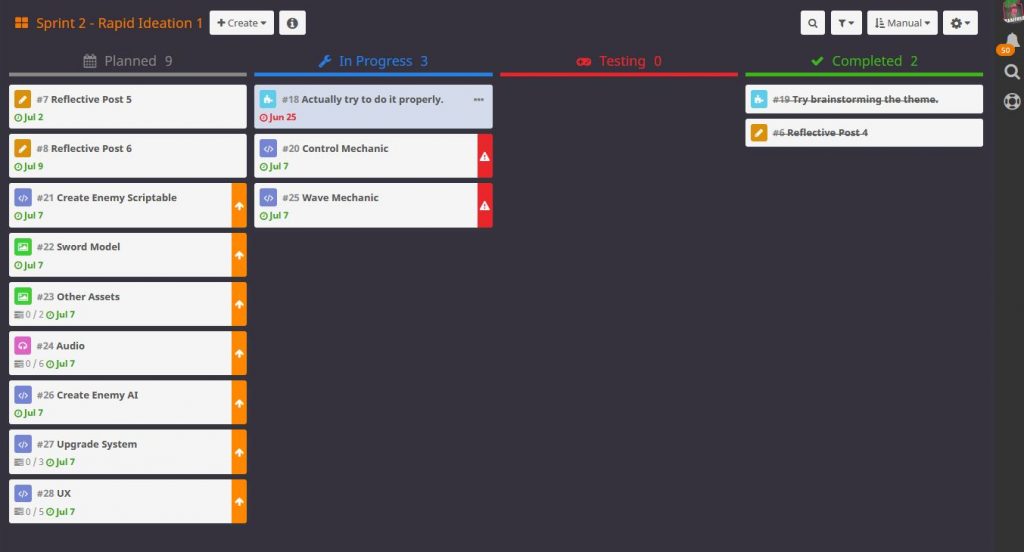
Something I explored a few weeks ago however was how the Agile methodology of planning a project seemed to be opposite to the way that a game project should or could be planned. Essentially in order to produce a game you need to know before hand all of the things you need to make, however Agile planning is an ongoing process.
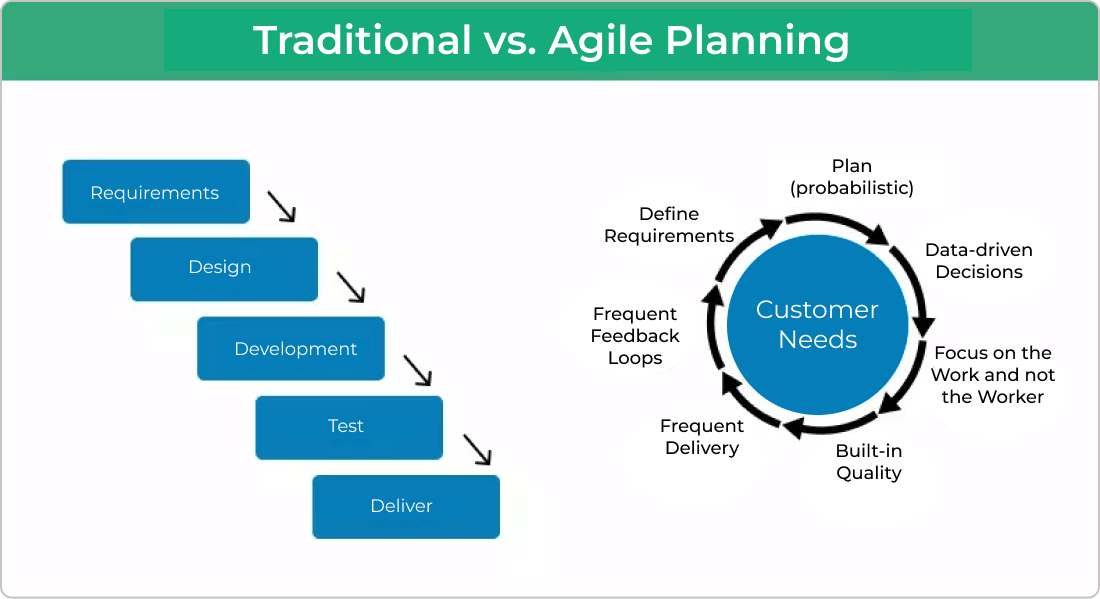
I investigated this in a previous blog post where I was able to attribute this kind of planning methodology to creating pitch documents and assets to a game project using it, and then using this to inform a more ongoing planning process. Basically creating a product backlog that can then be used to inform the sprints, with the more detailed planning of the aspects being applied during the sprints.
Obviously Agile methodologies have been adopted by the games industry at every level due to the benefits of being able to adapt the product through the life cycle of development. As Clinton (2010) states “…imagine that you and the entire project team could go back in time to the beginning of the project and start all over again. Would you do anything differently?”. Agile methods allow you to do this.
I am interested in exploring more Agile methods within the process and see how they can be suitably applied or discounted where necessary.
Reflection
Well as part of my reflection throughout this module and the new learning I gained in reflection I set myself the following SMART target.
Improve my reflective practice by utilising the 5 key skill domains within my weekly reflective blog posts throughout the rest of the module. I will detail this progress through a summative post illustrating the use of the domains in table format with analysis to observe my development. This post will be written before the module deadline of 24th August.
https://blog.robcharlish.co.uk/2021/06/30/reflective-domains-and-smart/
So if we look back at what my usage of reflective domains was during this week we see the following.
| Dispositional | 5 |
| Affective | 7 |
| Interpersonal | 3 |
| Cognitive | 8 |
| Procedural | 7 |
So without knowing I had applied a lot of the reflective domains within my reflection, I am putting this down to my previous experience of teaching and my PGCE qualification. Cannot say that I was aware I was doing it but I am now.
So looking at it now with a complete set of posts this is what I ended up with.
| Dispositional | 16 |
| Affective | 15 |
| Interpersonal | 7 |
| Cognitive | 13 |
| Procedural | 17 |
Looks like I am just not a people person, but actually that is not a fair statement really. We have not had much opportunity outside of study pods to really develop in a group way, and I have been engaging with other people quite a lot on a practical level through my relevant communities. It just is one of those things that I mentioned earlier that I do autonomously and does not seem like something I need to pinpoint. Again assumption is probably going to get the worst of me.
I am happy about the fact that the dispositional and procedural domains have come out on top. This illustrates to me that my motivations have changed and they have some drive behind them, and that I am developing. These were my two major concerns taking on this course, would I be able to motivate myself and learn something new (what with be old and all) and it looks like I am. This can only be a positive thing and something I need to make sure I continue to do.
Version Control
Now this is where I really did notice that I was stuck in a repetitive groove. For the last 4 years I have been using Unity Collaborate for version control on all my projects and have been teaching it to students for their projects. It worked for me and the students, we found it effective for our needs. However during dicussions in study pods about this it came to my attention that Unity had actually stopped developing Collaborate in favour of supporting external providers instead, as stated by one of the developers (2019) “..it has become clear that leveraging proven backend solutions such as Plastic SCM, Perforce, and GitHub is more likely to succeed at reaching those goals within a reasonable time frame.”
So it was at this point I knew I had to get back into the habit of using these external providers rather than relying on collaborate to make sure that I could work outside of my own organisation. I explored this during Rapid Ideation 2 and was able to get back into the swing of Git really quickly. It was interesting to see the developments that have been made with the large file system aspects, one of the major downfalls and why I switched to collaborate 4 years ago.
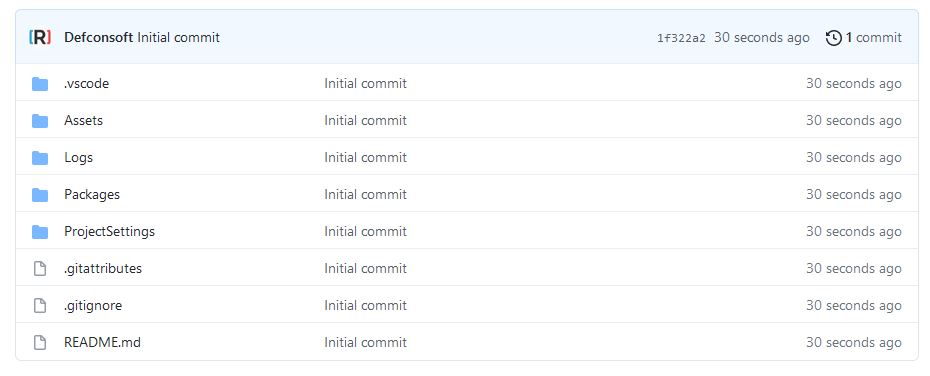
While I did not really need this project in the end for Rapid Ideation 2, it was well worth it to check my knowledge and ensure it was still functional. It also allowed me to set up the software environment on my machines so that when it is needed, and it will be, I will ready to go straight out of the box.
Communities of Practice
As described by Fredin (2018) “Having a strong network of friends and colleagues in a wide variety of professions is a great way to find new work and explore new avenues of opportunity in your industry.” I cannot agree more with this statement however I would extend upon it. For me the networks that I have built are somewhat of a support structure that I can visit in order to gain assistance in things and to further my knowledge, it is not just about jobs or opportunities.
I am a member of two local organisations, Game Makers Yorkshire (GaMaYo) and Game Republic. Both of these groups contain a large amount of industry professionals that meet and discuss all things games with each other. I have even spoken at events run by Game Republic and provided exhibition aspects for different events.

This to me is a really important part about networking and communities, your contribution that you make to them. I have also recently discovered Into Games and their video game ambassador program which is run in partnership with UKIE. This program allows schools, universities or youth groups to connect to a large industry network of professionals to provide talks, workshops and any kind of information about the games industry and its careers.
It also comes with an extensive discord group which has a huge gathering of people, both professional and from education, that encourages discussion and feedback about all things games industry.
Moving Forwards
So a few weeks ago I had an epiphany, it went something like this.
to create my own company to make hyper casual games that I can run alongside my existing career in education
https://blog.robcharlish.co.uk/2021/07/19/reflections-week-7/
So remember at the start when I said the only reason I was on the course was to get a qualification so Academia would notice me. Well that is gone and it has been replaced with this. This is my full driving force now as I have had my norms tested during this module and it has shown me that I have been stuck in a groove for too long and I need to disrupt something in order to continue to be that expert I spoke about at the start.
I need to make sure I am continually running those three tests described by Ericsson to ensure that I am maintaining my level of expertise to the level that I want it to be at. The attraction of hyper causal games is something that has been with me for a little while now. I consider them to be harder to make more involved games due to their specific requirements. They have to be fun!
I have looked over the remaining modules and have been able to identify some ways in which I will be able to work towards that goal above within the rest of the content. So I have put together the following SMART targets for the rest of the course.
Smart Goal 1
Utilise the Indie Game Start-Up module to explore the finer intricacies of working as a freelance developer while also holding full time employment. Ensure that I can be fully recognised as an independent company alongside my employment while considering all the legal, ethical and financial based implications. By the end of the module I should be able to have all required knowledge and documentation complete to initiate, from a legal point of view, the above goal.
Smart Goal 2
Utilise the Game Development module to develop a hyper casual multi-platform game to a publishable standard. Within this I will explore the common aspects of hyper casual game play mechanics and the audiences that consume this kind of media. By the end of the module I should be able to develop a publishable game that will incorporate all aspects of successful hyper casual game thinking.
Smart Goal 3
Utilise the Co-Creative Design & Development Practice module to further extend my team working abilities and explore a more in depth version control practice utilising external providers. Endeavor to join like minded individuals from a selection of disciplines in order to produce a product that allows everyone’s goals to be achieved.
Smart Goal 4
Utilise the Major Project module to launch the aforementioned business and release its first title.
So yes that last one is pretty short in hitting the SMART goals but there is a period of time to go before I even attempt that one, I am sure it will develop more over time. Or perhaps not, maybe short and sweet and too the point is enough.
References
Charlish, R (2021) Reflections – Week 1. Available at: <https://blog.robcharlish.co.uk/2021/06/04/reflections-week-1> [Accessed: 18th August 2021]
Ericsson, K., Prietula, M. and Cokely, E., (2007). The Making of an Expert. [online] Harvard Business Review. Available at: <https://hbr.org/2007/07/the-making-of-an-expert> [Accessed 30 July 2021].
Ericsson, K., 2004. Deliberate Practice and the Acquisition and Maintenance of Expert Performance in Medicine and Related Domains. Academic Medicine, 79(Supplement), pp.S70-S81.
Griffin, W., 2008. From Performance To Mastery: Developmental Models of the Creative Process. Journal of Advertising, 37(4), pp.95-108.
Petty, G. (n.d) Creativity – Geoff Petty. [online] Available at: [https://geoffpetty.com/creativity/] (Accessed 12 June 2021).
App.hacknplan.com. 2021. HacknPlan. [online] Available at: <https://app.hacknplan.com/> [Accessed 18 August 2021].
Clinton, K., 2010. Agile Game Development with Scrum. Pearson India.
Intogames.org. 2021. Start your journey into games now. [online] Available at: <https://intogames.org/> [Accessed 18 August 2021].
Gamesambassadors.org.uk. 2021. [online] Available at: <https://gamesambassadors.org.uk/> [Accessed 18 August 2021].
Fredin, N., 2018. The Importance of Networking. [online] Cgspectrum.com. Available at: <https://www.cgspectrum.com/blog/the-importance-of-networking> [Accessed 18 August 2021].
Unity3D. 2019. Collaborate Update v1.3.2. [online] Available at: <https://forum.unity.com/threads/collaborate-update-v1-3-2.783266/> [Accessed 18 August 2021].
Technologies, U., 2021. Unity – Manual: Installing from a Git URL. [online] Docs.unity3d.com. Available at: <https://docs.unity3d.com/2019.3/Documentation/Manual/upm-ui-giturl.html> [Accessed 18 August 2021].
Rubino, G., 2021. Blog Feedback. [email].
Figures
Feature Image: Photo by Sigmund on Unsplash
Figure 1: Griffin, W., 2008. From Performance To Mastery: Developmental Models of the Creative Process. Journal of Advertising, 37(4), pp.95-108.
Figure 2: Charlish, R (2021) ‘ICEDIP applied to my process’ Created on June 12th 2021
Figure 3: Charlish, R (2021) ‘Final Prototype’ Created on 22nd June 2021
Figure 4: Charlish, R (2021) ‘Basic game’ Created on July 3rd 2021
Figure 5: Charlish, R (2021) ‘Hack n Plan project managed’ Created on 25th June 2021
Figure 6: Kanbanize, n.d. Differences between Traditional and Agile Planning. [image] Available at: <https://kanbanize.com/wp-content/uploads/website-images/Agile/traditional_vs_agile_planning.png> [Accessed 8 August 2021].
Figure 7: Charlish, R (2021) ‘First Github commit’ Created on 22nd July 2021
Figure 8: Wakefield College, 2019. Rob Charlish giving a talk at the Festival of the Moon event. [image] Available at: <https://pbs.twimg.com/media/ED29NuvXYAAIRzj?format=jpg&name=large> [Accessed 18 August 2021].


0 Comments